
From losing his father to terrorism and watching conflict tear apart his family, to nearly abandoning football before leading Iraq back to the World Cup, Aymen Hussein has overcome obstacles that would have broken many others.
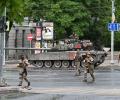
The Centre informed the Supreme Court that ten Indians have died while fighting alongside Russian forces in the Russia-Ukraine war. The court is hearing a plea seeking the repatriation of Indians allegedly forced to fight.
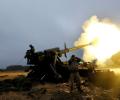
They said the agency has found 35 instances in which youngsters were taken to Russia after being lured with false promises of high-paying jobs via social media channels and local contacts and agents.

A tanker carrying liquefied petroleum gas (LPG) for India has successfully navigated the Strait of Hormuz and is en route to Visakhapatnam, India, carrying enough cargo to meet half a day's requirement for the country.

History is rarely decided by who has the biggest weapons, but by who has the better process. The same rule applies to investing, says Ramalingam Kalirajan.

A group of seers, led by the Akhand Parshuram Akhada, has launched a campaign in Uttarakhand's Haridwar to ban the sale of food under the name "veg biryani".

Israeli Prime Minister Benjamin Netanyahu defended his actions amid growing resentment over an emerging US-Iran deal, asserting that Iran would never possess nuclear weapons. He faced criticism from opposition figures like Naftali Bennett and addressed concerns about Israel's security zones and relations with the US.

Economist Jeffrey Sachs saw Gulf nations' decision to partner with the US through the Abraham Accords as an "invitation for disaster" as it made them more dependent on American protection.

Iran has reportedly allowed select "friendly nations" including India and Pakistan limited access to the Strait of Hormuz amid ongoing conflict, easing some energy supply concerns. Here's what the move means for global trade and oil routes.

For the foreseeable future, the most likely outcome remains continuation of the status quo. Taiwan will remain self-governing without formally declaring independence, while China continues to apply sustained pressure short of war, predict Krishnan Srinivasan and Manoj Mohanka.

The AI-enabled system detects nine types of errors in the kitchens that are primarily responsible for unhygienic food on trains.

In a statement issued following the announcement of the US-mediated deal, Qassem characterised the agreement as a 'humiliating' and 'shameful' surrender of Lebanese sovereignty that prioritises Israeli and American dictates over the nation's independence.

Indian benchmark indices, Sensex and Nifty, closed sharply higher, with the Sensex climbing 1,695.40 points and the Nifty surging nearly 2 per cent, driven by a global market rally and a decline in crude oil prices following US President Donald Trump's declaration that his country has ended the war with Iran.

'Every day the meter is ticking. Like a time bomb.' Shipping giants are billing Indian exporters up to $3,000 per container in war surcharges -- on cargo that sailed before the war began -- as the Strait of Hormuz shuts down.
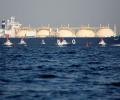
A Liquefied Natural Gas (LNG) carrier, chartered by an Indian firm, safely transited through the Strait of Hormuz -- the first Indian LNG tanker to cross the war-hit narrow shipping lane since the war in West Asia broke out more than three and a half months back.

An Indian-flagged crude tanker safely departed from the UAE's Fujairah after loading oil, despite an attack on the oil terminal. The Indian government is closely monitoring the situation in West Asia to ensure stable fuel supplies and maritime safety.

Iran is fighting a different war: Older, slower, and in some ways more dangerous. Iran doesn't need to shoot down an F/A-18. It only needs to make the Strait of Hormuz feel dangerous long enough for insurance markets, shipping companies, and oil futures traders to do the rest. Prem Panicker continues his must-read daily blog on the war in the Middle East.

With Mariachi costumes, trumpets, and a sea of dark green support, Mexico City has opened the World Cup on Thursday, as fans packed the famous Azteca stadium ahead of the opening game between Mexico and South Africa, amid a backdrop of protests around the capital.
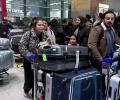
A group of Indian sailors recount their harrowing experience of being detained in Iran on suspicion of smuggling, and their subsequent escape from the country as regional tensions escalated into open conflict.

The question is no longer whether the war will expand. It has. The next few days will tell us whether the war stabilises around Hormuz or whether the Strait itself becomes the trigger for a far larger rupture. What to watch for over the next 48 hours is simple: Any move by the US toward direct naval control of the Strait; any credible Iranian attempt to disrupt or mine shipping lanes and, critically, whether energy infrastructure in the Gulf continues to be targeted.If those lines are crossed in tandem, the war will no longer be containable within the region.

US President Donald Trump has claimed that Iran's missile capabilities have been severely degraded, saying Tehran now possesses only a fraction of the arsenal it had before recent hostilities.

AI reduces the time taken to find a target and launch a strike. This has led to a major increase in the pace of the conflict, with one report mentioning nearly 900 strikes launched on Iranian targets in the first 12 hours of an operation.

Despite initial pressure from the West Asia conflict, analysts are optimistic about the Indian hospital sector's outlook, citing strong demand drivers and ongoing expansion plans that are expected to fuel significant revenue growth over the next few years.

Prime Minister Narendra Modi urged US President Donald Trump to prioritise the safety of Indian seafarers in the Strait of Hormuz during the implementation of Washington's proposed Iran peace deal, as both leaders focused on repairing strained bilateral relations at the G7 summit.

Former world blitz and rapid champion Anna Muzychuk discusses the upcoming World Chess Championships, highlighting the importance of psychological momentum and pressure handling for Indian players D Gukesh and R Vaishali.

An art exhibition in New Delhi showcased drawings by children killed in a school bombing in Iran, offering a poignant reminder of the human cost of conflict.

Indian-flagged vessels are navigating the Strait of Hormuz safely despite ongoing tensions in the region, ensuring the continued flow of vital energy supplies to India.

This weekend, Donald Trump has begun to say the quiet part out loud -- that he wants to take control of Iran's oil, a formulation more in line with his robber-baron style of international relations.

'After we were alerted about the war, none of us could sleep for the next two nights while sailing through those waters.'
Several Indian families are in mourning after their sons, who travelled to Russia on study visas, were allegedly deceived into joining the Russian army and subsequently killed in the Russia-Ukraine conflict. The families are demanding answers and seeking assistance to bring their sons' bodies home.

'Was the five-day pause ever meant to hold, or was it simply another instrument of signaling, of positioning, of buying time in a war where even the pauses are tactical?' asks Prem Panicker in his must read daily blog on the Gulf War.

The United Nations Security Council presided over by United States Secretary of State Hillary Clinton on Thursday unanimously adopted a resolution condemning sexual violence against women in war zones.

With several Indians still stuck in strife-torn Ukraine, the government is pushing out videos on various platforms, including social media, on how to remain safe in a war zone.

Amid escalating tensions, Iranian Deputy Foreign Minister Saeed Khatibzadeh declares Iran's unwavering commitment to a 'heroic nationalist defence' against perceived American and Israeli aggression, vowing to resist what he calls an 'invasion' to the very end.
United Nations on Thursday began running special rescue convoys and evacuated hundreds of wounded Tamil civilians from behind the Tiger-held areas as concerns grew worldwide over the fate of 250,000 civilians trapped in the war zone. "About 350 critically-wounded civilians, including 50 children, were brought to safety zones," UN spokesman Gordon Weiss said.

'Even as the National Guard kept up the show of strength, safety was kept in mind.' 'Their guns were not loaded. They didn't want to scare people unless they posed a threat.'
'India was not obliged to protect the Iranian ship.' 'Once the Iranian ship left Indian waters, she was on her own.' 'Guilt tripping India is wrong.'

Indian benchmark equity indices Sensex and Nifty surged in early trade, driven by a sharp correction in crude oil prices below USD 100 per barrel and a rally in global markets, fuelled by improving sentiment surrounding US-Iran negotiations.

Chinese leaders, including its generals, will have to weigh whether they can win a war if they ever attack Taiwan and if at all, can they sustain the subsequent devastation, notes Rup Narayan Das.

Bollywood has announced plenty of high-profile sequels with fanfare, only for a few of them to vanish into endless delays, casting chaos and development hell.
